IYC Panel Transcript from the Philly Bike Expo 2026
[00:00] Melissa
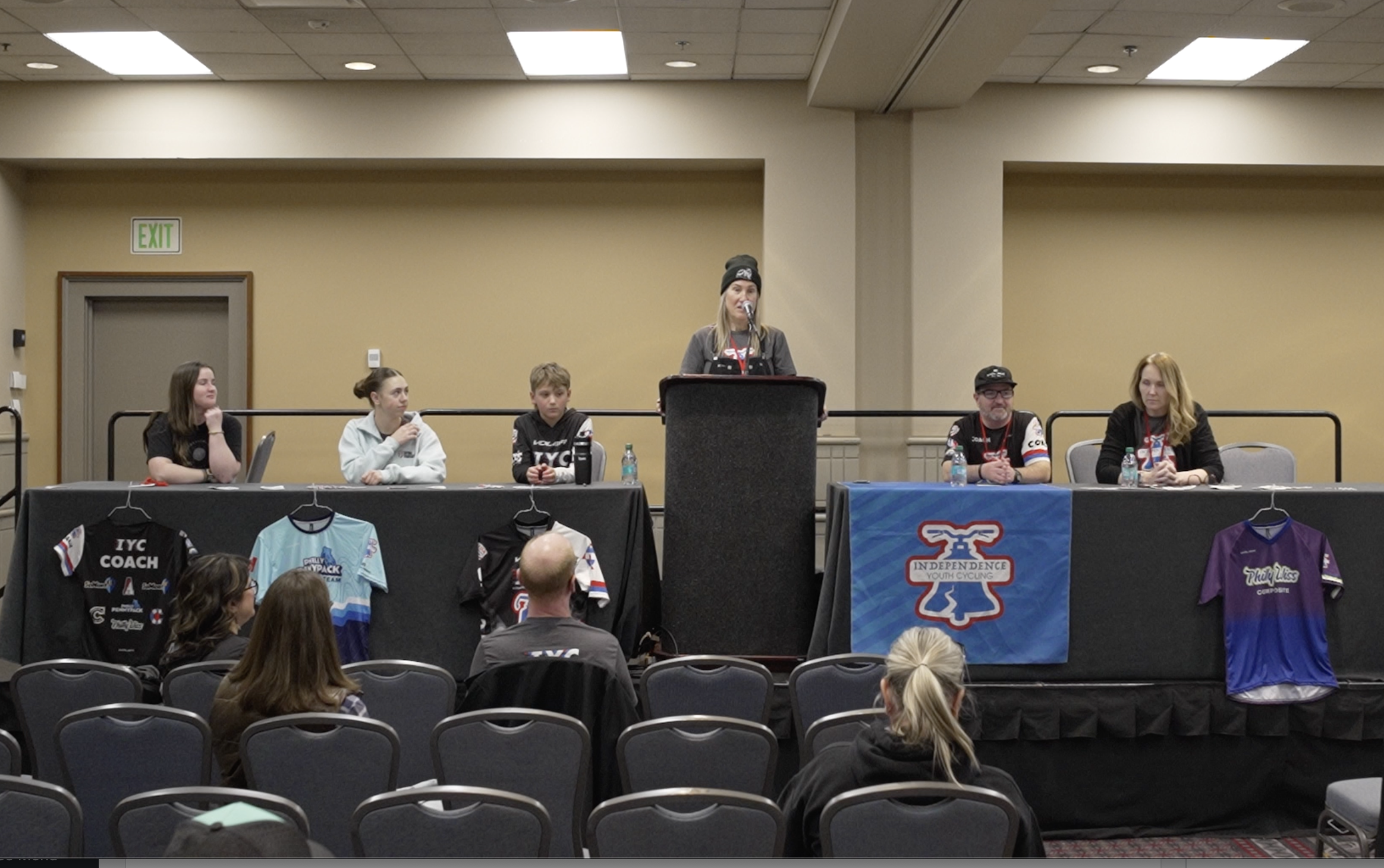
So, we are recording this panel discussion, and we’ll probably have it up on YouTube. In the future, people will be watching it, and hopefully they will find out a little bit more about Independence Youth Cycling, what our mission is, and hear the voices of our lovely panelists today.
So, thank you all for coming to this seminar, and just off the bat, let’s give our panelists a big round of applause for being here today and letting us hear their voices.
Good afternoon. We are Independence Youth Cycling. We’re a 501(c)(3) nonprofit, and our membership reaches the greater Philadelphia area — as far east as South Jersey, northwest as far as Emmaus, and southwest as far as Reading, Pennsylvania.
So we have membership far and wide. We are also in, I think, our 10-plus years of existence. We started in 2016 with only nine youth cyclists, and year over year we’ve grown exponentially after that. So it’s gotten really big, and I think 2026 is gearing up to be our largest year yet, so it’s pretty exciting.
Our mission is to empower youth through the power of cycling. We also foster diversity and inclusive communities, and we are teaching kids to be independent, to be strong, and fostering skills that we hope will carry forward from just the beginnings of riding to adulthood.
And with that, I’d like to introduce myself. My name is Melissa, and I’m actually a newly minted board member of IYC. So I’m super thrilled to be able to share my experience in cyclocross. Dave and I are doing the cyclocross team together, and I’m also bringing my experience in logistics and communications. So I’m pretty stoked about helping to serve the board.
Without further ado, I’m going to introduce our panel.
John Raisch is the founder and president of IYC. He’s a lifelong Philly cyclist with roots on the trails of Pennypack and the dirt of the Wissahickon. After launching SoMont in 2016, he turned his passion into Independence Youth Cycling, creating a nonprofit that now supports six teams and a full bike fleet. He’s definitely the engine that’s building the pathway from dirt to adulthood.
Regina is our mentor. She’s a busy optometrist by day and mother of twins. Regina went from a non-rider to a team director, and she’s one of our strongest endurance coaches. She’s a fierce advocate for getting kids off screens and into the dirt, using the bike to build confidence that lasts a lifetime.
We also have our student and youth panel over here.
Colton is our spark. At just 11 years old, Colton is our multidiscipline dynamo. From balance bikes to placing fourth in his age group at the 2025 Cyclocross Nationals, he’s a reminder of why we do this. With dreams of European racing and the Olympics, he is the future of the sport.
Selah is our bridge. A competitive junior racer from Womelsdorf, PA, Selah is a force on the varsity circuit with multiple podiums in the MASS series and a fourth-place state ranking. She represents the critical high school years where grit and form meet. She’s already eyeing the next level: collegiate racing.
Maris is our proof. A former SoMont student-athlete turned coach, Maris is living the long game. Now a mechanical engineering student at RIT and president of RIT Cycling, she proves that the skills learned in the woods of Philly translate directly to leadership on a university stage.
So that leads us to what our panel is about today. It’s about the long game. It’s about starting kids as young as Colton and seeing them transition through to young adulthood and into their university years. We’re also going to peel back the curtain a little bit on the logistics of running a youth cycling organization. So John will share with us some of the challenges and exciting times of putting this together.
Okay. First of all, our first question is for Colton.
[05:51] Melissa
Colton, you’re racing three disciplines—
[06:00] Colton
Mountain bike. Actually, four: mountain bike, cross, track, and road.
[06:02] Melissa
Which one feels like home right now? And what’s the coolest skill you’ve learned by switching in between them?
[06:15] Colton
My favorite sport right now is cyclocross. And the coolest thing I’ve learned is track stands and doing starts.
[06:30] Melissa
Awesome. Can you tell us a little bit more about why cyclocross is your favorite sport right now?
[06:36] Colton
It’s been the one I’ve been training the most, and it’s a lot of fun.
[06:44] Melissa
Awesome. Thanks.
Selah, the next question goes to you. Many athletes quit in high school. What’s the one thing about your team that makes you choose the bike over everything else on a Saturday morning?
[06:59] Selah
IYC really injects a lot of fun into the morning rides or afternoon rides, whether it’s with a group of people or you’re riding by yourself. It’s so much fun.
[07:22] Melissa
Okay. Maris, the next question goes to you. As the original inspiration for IYC, what’s it like seeing this 11-year-old, Colton, on stage today? Does it feel like the mission you started is working?
[07:41] Maris
Yeah, definitely. It’s pretty empowering, kind of seeing someone else follow in, I guess, my footsteps. The foundation that we worked to build is really working.
[08:00] Melissa
Thank you, Maris.
Okay, our next question is for Regina. Regina, you joined IYC about eight years ago as a non-rider. What was it about IYC culture that turned a spectator into one of our strongest coaches and a team director for two years?
[08:30] Regina
Okay, so as many of you know, I have 18-year-old twins. My husband, who’s also very involved in the team, started mountain biking about 10 or 11 years ago, and he got my son involved at the time.
As a parent of twins, we try to keep our interests separate. My daughter was doing her thing, my son was doing his thing, but very quickly my daughter started really finding joy in the sport as well.
Cole joined the Viking group in his first year as a sixth grader and immediately fell in love with the sport. IYC SoMont at the time was just an environment where he could thrive individually, but also with a very strong team culture. So that’s what attracted us initially.
And then not only did the kids find friends, the parents found friends within the community, and shortly thereafter my daughter got involved, and then I was the only one that wasn’t biking. So then I got a bike, and I actually had to learn how to mountain bike, and that was a process.
But as soon as I gained some confidence, then I felt comfortable riding with the team, and then really sort of found some confidence to start leading rides. It’s been an experience that I have found great joy in, and even though my kids are now graduating seniors, my husband and I are both very excited to continue to ride with the group. We definitely enjoy the culture so much that we can’t see life without it at this point.
[10:22] Melissa
Great. Thank you.
So our next question is for John, our founder. John, what was the very first logistical hurdle you had to clear to get this engine off the ground in Philly?
[10:39] John Raisch
Hello, everyone. Let me first just say thank you to Melissa for putting this idea on the table and having us here today to talk about this project that has become a big part of my life and my family’s life and all of our lives here. So thank you for suggesting this, and to the crowd as well.
You know, I’m an entrepreneur at heart on the tech side. As a matter of fact, it was in 2015 here at the Bike Expo that I met the founding team from the Pennsylvania Interscholastic Cycling League, and they were looking for suckers like myself to start teams.
And Glynis, my wife, and my daughter Maris, and my son Johnny — we were all here — and we just kind of looked at each other and were like, this is a no-brainer. We’re totally doing this.
So, your question about what was the biggest hurdle — we have NICA DNA in our organization, and the affordances that NICA provides are amazing. I don’t think I would have started this without the affordances that NICA and the Pennsylvania League provide. So for me as an entrepreneur, seeing the structure that was provided was really — I’m kind of answering your question from a different angle — it really provided a number of components that I would have probably not gone off and tried to figure out on my own.
So things like insurance, league events, registration, coach background checks, and my most favorite thing is the training that the league provided to coaches.
Prior to meeting PICL, the PA League, I had mountain biked my whole life in all the parks that you mentioned at the beginning, but I never considered myself a cycling coach. I had spent many years on the baseball field and on the soccer field and in boardrooms for little leagues, but it never kind of dawned on me: could cycling be a coaching opportunity for me as an adult?
And when I found out what PICL was all about and the national program, and the fact that all of these things were provided to us, again, it just kind of made the process of starting a team a lot easier.
So I’ll stop there, and we can talk later about how IYC fills in other gaps, but really our DNA is NICA and PICL, and it just allowed us to expedite those early years into what we have today.
[13:33] Melissa
Thank you. As a follow-up question to that: IYC has six teams currently, and we’ve got three organizational bodies that we are actually rolling up into, including NICA, Mid-Atlantic, and also USA Cycling.
Would you consider that a more complex organization, and how does that differentiate us? Does it add more logistical issues for the organization?
[14:13] John Raisch
So, we have currently six PICL/NICA teams that operate under the guidance of the nonprofit, but then inside of PICL and NICA, as far as the league and the series that they operate, our Mid-Atlantic Super Series mountain bike team and our cyclocross program are in addition to the six.
Again, those teams operate in leagues and series outside of anything IYC produces. IYC is not a league. We’re not a series producer. We don’t produce events.
So, the growth or maturation of our activities into MASS mountain biking and cyclocross were really organic. We have a great community of people — many of us in the room here today — that really make up the best of what we do. So it’s really all of our collective ideas that go into driving the future.
To more specifically answer your question, we built a great base, a great foundation — really a platform for youth cycling. So who knows where we might go in the future, but the platform we’ve created could easily allow us to create a BMX team or a track team. We have all the components that exist. It’s just a matter of: does it make sense? Do we have people to kind of drive those different programs?
[15:59] Melissa
So, Colton, back to you. You’re going to be participating in the Mid-Atlantic team and the cyclocross team. Tell us more about how you’re feeling about that.
[16:15] Colton
Not feeling good going into the series for mountain biking. Not ready. And for cross, we usually try to do all the races — not usually, like, we do all of them — and then we do the ones that we like that are far away.
[16:41] Melissa
Colton, when you’re facing a technical section or a muddy hill, something that’s maybe a little scary, how does having a coach — let’s say like Regina, though I know Regina’s not your coach, but a coach in your life — help you get through it? Do you have a memory of an instance where that really helped you?
[17:13] Colton
I use sessioning usually, and body position. If I come into it a different way and my dad wants me to do it a different way, he’ll have me do it in a different body position.
[17:32] Melissa
So is your dad your favorite coach right now?
[17:37] Colton
Nice.
[17:45] Melissa
Back to you, Selah. You’re a junior in high school, so you’re probably thinking about colleges and universities and what’s the next step for you. Has IYC helped you to realize that cycling doesn’t have to end in high school after getting your diploma? Tell us about your plans and what you’re looking for.
[18:07] Selah
IYC has shown, with so many coaches, that you can continue cycling after high school. It doesn’t have to end in high school.
There are so many races where it’s not just 18 and under. There are categories for all ages. And so many people that you meet are, a lot of the time in my case, twice as old as me, or at least a little bit older. And they all bring so much wisdom, and cycling is kind of like a lifestyle. It’s not just racing.
The racing is really fun, but you can do it your entire life. So many of you guys have shown that you can do it your whole life, and you can do it with your kids once you have kids and stuff like that.
And also it’s shown that in college there are so many different types. Whether you’re on a team or there’s a club, you can join and help influence that club and bring more people to the sport, because I think everyone should bike.
[19:17] Melissa
Awesome.
Maris, this is a great lead-in for you. At Rochester, you led the team. What IYC skill did you use most to manage a university club and its budget? Can you tell us more about your involvement, how you decided to take on that role, and what it looked like?
[19:44] Maris
Yeah, I mean, I definitely took a lot of inspiration from the stuff that SoMont did at the beginning and then the stuff that IYC is doing now.
I think I really take to heart the idea of having a well-rounded kind of events structure. It’s not always all about racing. We try to get everyone interested, even if you’ve never done this before and you’re interested to try it out, or you just ride around campus. We try to have a thing for everyone.
[20:22] Melissa
Cool. Were there many women on the team?
[20:31] Maris
So, when I first tried to race for RIT, there were no women on the team. I had kind of heard whispers that there was a girl a couple years ago and they would tell me about her.
But the first year I raced by myself with a bunch of guys. It was a little bit disheartening, but I had been biking my whole life and it was just like, I’m going to do it whether I like it or whether they like it or not.
They were never discouraging. They were always super nice, and I’m now friends with a lot of them. But one of the things that really helped me get through it is knowing that at the races we went to, we met up with a bunch of other schools and some of my friends went to those other schools. So I would survive the seven-hour car ride to Vermont so I could hang out with my friends who were there.
And I think after that first year, I had it in my head: all right, I’m going to be on the leadership team for this. I think it’s important to just be in that room. Being behind the table at our activities fair, just being there makes it a little bit easier for another girl to come up and be interested. So I think just showing up can make the difference for someone else.
[22:04] Melissa
Thank you.
Okay, let’s go back to this side of the table. Regina, as team director for SoMont and SoMont East in Abington, you get to manage a lot of moving parts, not just bikes. What’s the biggest challenge in taking a kid from the nervous beginner to a confident rider?
[22:34] Regina
I think from a team director standpoint, it’s a little bit just about having some good organization. We’ve had some great team directors in the past that have passed on a lot of great information and knowledge. Then you can take that knowledge and incorporate it into what works best for you.
I myself am fortunate that even though I have two teams that I’m keeping track of, my husband is helping me and we’re co-directors, and now Jenny is going to be helping us as well. So the fact that we’re able to then pass on the knowledge to the next person is really helpful.
And then as far as taking maybe a nervous student-athlete, we have a really good program, as John was saying, starting with our NICA foundation through PICL. We have really good foundational training that we do with those athletes so they are able to be confident on their bikes and learn the skills.
We start the initial part of the season with some basic skills. Even if kids find it a little bit boring to start, at least we’re planting the seeds of that constant foundation.
Then we pretty immediately go from just some on-the-bike training to getting out on the trails, and that I think builds confidence. Even for some riders who may not be the most confident on the trails, we have coaches that also have varying abilities that allow them to then be confident in their ride.
Not everyone has to be fast and go the farthest. It’s a lot about just being comfortable with who you are and who you’re riding with. And I think that fosters a lot of really good, strong riders within our organization.
[24:12] Melissa
Thank you.
For John: how do we handle equipment equity? How does the engine ensure a kid without a bike can still become a strong rider or college leader?
[24:42] John Raisch
So, equipment equity. Yeah. We acknowledged early on, even in our first year, that we wanted the sport to be accessible to anybody that approached us.
So, in our early days, we basically just gathered up a bunch of used bikes or retrofitted some older 26ers into bikes that younger kids could ride. And when families came to us who expressed interest, who didn’t have the right equipment or didn’t have any equipment, we had options for them.
When you’re eight or 16 or 25 student-athletes, it’s easier to manage six or eight bikes. Fast forward to kind of where we are now, we have a bike fleet of probably close to 50 bikes. About 15 of them or so are cyclocross bikes, the others are mountain bikes.
As our timeline matured, so did the organizations around us. NICA and PICL, as their programs grew and their relationship with Trek grew, they conceived programs where we could apply for bikes to then share with our community. So we took advantage of those opportunities.
If you look at our cyclocross program, our lead sponsor, along with Voler Apparel, is Guys Racing Club. Guys Racing Club single-handedly has built our fleet of cyclocross bikes because Dave Berson, who runs that program with Melissa, basically just said, “Hey, here’s what we’re doing. We’re looking for bikes.” And the club was great. Literally within a year, we aggregated a fleet of cyclocross bikes.
I think what’s great about the cyclocross bikes is cyclocross is a lesser-known cycling discipline, but with mountain biking, we’re able to introduce student-athletes to the sport of cyclocross. They could ride a mountain bike and that’s just fine, and as they get more interested or competitive, we have that fleet of bikes for them to try before they’re going out and buying something on their own.
[27:26] Melissa
So Colton, back to you. Considering what you’ve heard from Selah and from Maris — junior in high school, sophomore in college — how does that make you feel about your future in cycling, listening to these two ladies over here?
[27:48] Colton
Wasn’t really listening.
[27:51] Melissa
Thank you for being honest. That’s okay. Let’s switch up the gears. Where do you want to be with your bike when you’re 18? What’s your big dream race?
[28:09] Colton
When I’m 18, I still want to be racing and having fun on a bike. And my dream race is cyclocross worlds.
[28:20] Melissa
That’s a pretty big goal. Do you think you’ve got the infrastructure to get you there? All right. Good, good.
So, Selah, what’s one piece of advice that you would give to a middle schooler who’s nervous about their first bike race?
[28:43] Selah
I would have to say that your first race, you’re going to be so nervous. And it’s okay to be nervous. You kind of have to ride the emotion.
For your first whole season of riding, when you start racing, you’re nervous for every single race. And as much as you’re nervous, everyone around you is nervous. Some people might cover it better by looking so serious and looking really, really fast, but I promise you, they’re just as nervous as you are.
[29:20] Melissa
That’s great. Thank you.
So, Maris, for the parents in the room, what is the one thing that they can do to support the long game without putting too much pressure on their kids?
[29:39] Maris
Yeah, totally. I really like this question. I thought about it a lot.
I think it kind of just boils down to remembering that there’s not one path to being up here today, being where we are. Like we were talking about with Colton, you race so many different disciplines. One season you might be really into cyclocross, and the next you’re really into racing mountain bikes for NICA.
So, kind of just watching that path meander until you find what you really like. And then it’ll kind of wax and wane, too. Maybe some seasons you’re just not feeling it. We talked about that age-18 burnout before. I think it’s important not to push it.
And it’s not always about racing all the time. If you’re not a top performer, you’re not getting the satisfaction of podiums at every race, that’s okay. You can just do it for fun. You could do long-distance endurance stuff. Maybe you want to be a coach and go into the educational side. Maybe you want to be a bike technician and learn about maintenance and stuff.
There are so many different pathways to doing bike stuff for the rest of your life.
[31:03] Melissa
Thank you. That’s lovely.
Okay, so back to Regina. You have a unique perspective. You’re a health care professional. You’re an optometrist. What have you noticed about developmental and wellness benefits for these kids when they swap screen time for trail time?
[31:30] Regina
That’s a great question.
As an optometrist, I’ve been in clinical practice for nine years, and I’ve been in a few different positions during that time. For about five years, I was in a smaller family practice setting where I saw a lot of children.
At this point, myopia, which is nearsightedness, has become more of an epidemic. There’s concern that by the year 2050, about 50% of people are going to be nearsighted because of all of the increased screen time and near-device time that we spend with our world within about three feet of us. Everything is there.
Seeing young children come in who already have high degrees of myopia, there’s a significant concern about potential pathological processes that are going to come from that. And no one really thinks about that, right? They just think, “It’s glasses. I’m just a little bit nearsighted.” But there is definitely an increased risk of pathological processes like glaucoma, cataracts, retinal problems, pathological myopia, which is pretty similar to macular degeneration, which I’m sure everyone’s familiar with — but young people get that, and there’s no treatment for it.
So there’s been a push in family practice to try to reduce the amount of time that kids spend on near devices, which again is really hard at this point because everything is near — devices at school and all that. We know that it’s going to become more problematic.
So if you can take a child and have them outside, off of their near devices, for at least one to two hours per day, we think that is going to significantly reduce the amount of myopia. And if we can encourage them to be outside, off near devices, and moving and exercising at the same time, that can address other epidemics like obesity and the mental health crisis as well.
The sport of biking addresses all those things. You’re outside, you’re moving, you’re exercising, it’s good for your well-being in so many ways. So I just can’t say enough about this for everybody as far as being a healthcare professional.
[33:43] Melissa
Thank you. Really good points.
All right. So John, looking at this panel, what is the next big gear for the IYC engine? Where are we going in the next five years?
[34:02] John Raisch
This is like, what do you want to be when you grow up? Or where do you want to be in five years when you’re graduating college?
That said, it’s really been an amazing 10 years. As I noted before, it’s crazy to think 11 years ago I was here hanging out with my family as cyclists, and fast forward — we’ve built this amazing organization.
We’re an all-volunteer organization. We are an awesome community, and we will go where the community wants to go. I wouldn’t say we have a strategic plan or anything like that, but there are some interesting things that we talk about.
Obviously, we are a grassroots organization. We are maturing. So making sure that our sustainability continues is really my number one goal.
When we started the team, for example — and I live in Cheltenham — the team that we started, we called SoMont. You might say, well, what’s that all about? When I started it, I knew I wasn’t starting it just for the kids in Cheltenham. I wanted to start something that was broader than that.
Did I know it would turn into something like this in 10 years? Not specifically, but directionally, maybe.
So the name SoMont came from Southern Montgomery County — kind of a ripoff of the cool California NorCal and SoCal. I’m like, yeah, let’s create a team called SoMont.
My number one goal is really sustainability of the club, making sure that we don’t grow too fast, making sure that we understand what our capacity is. As an organization, there have been years where we’ve gone too fast, too quick. There have been years where we’ve gone at, I think, an adequate tempo. So in lieu of a kind of big, crazy strategic answer, it’s really just maintaining the sustainability of what we do and growing where we think we can successfully.
When I think about answering that question from my heart versus my head, I answer it from the perspective of a Philly kid: Philadelphia is the perfect case study for having cycling teams all across the city.
Here in the city and in the immediate suburbs, as much as we are a top-six-or-so city in the country, we have amazing accessible green space and trails in highly dense neighborhoods. We also have the thing called the Circuit Trails, which connects us together, and with each year that network of trails grows. So it gives kids and families safer passage from their neighborhood to a green space.
So I think about the names of the parks in the city. We obviously know the mighty Wissahickon and my favorite, Pennypack. We have Belmont Plateau. And then we have these other parks that I think with time and investment — which the city seems to be invested in with their partners — we have parks like Tookany Creek Park and Cobbs Creek.
Even a new project that recently came across my radar in North Philly, an area called Wister Woods, which backs up against La Salle University — there’s momentum of some riders to build trails in this park.
So I’d love to see team accessibility for basically every kid in the Philadelphia area.
[38:15] Melissa
Great. Thank you.
And now I’m going to open up to questions and answers. So that concludes our panel discussion. If you have a question, please come on up.
[38:39] Matt
Hey, I’m Matt. For those of you who don’t know me, I’m a coach on the IYC mountain bike team. So, good to meet you.
I love this topic. When you pitched this topic, it resonated with me. I’ve been mountain biking since I was 12, but originally I was a runner.
You talked about burnout. I started running competitively in sixth grade, and by the time I got to my junior year, it was getting old. Distance runner, cross country in the fall, indoor track, outdoor track, summer camps — and by the time I got to my senior year in high school, if I saw one more set of hill repeats or intervals, I was going to throw up.
I literally walked away from it probably in the middle of the indoor track season my senior year, and I did not run for 20 years.
And I see — mostly with our boys — it seems to be more with our boys around junior year in high school. Maybe they’re not into the cross-country side anymore. They still want to ride, but there’s more of a gravity element. They want to go downhill. They want to do tricks.
One of the great things about cycling is that there are so many disciplines. Colton, you’re doing all the disciplines, and I think we should continue to foster that.
So I wanted to ask you guys: hopefully you’re not burning out yet, but for Selah, I’m curious if you’re starting to see any signs of that as a junior. And Maris, I noticed that you shifted to enduro for the coming season, and I was just wondering if you could talk about your path from heart-rate-pinned-for-an-hour-and-a-half cross-country racing to maybe going to do some enduro.
[40:52] Selah
Actually, funny enough, I used to be a cross-country runner too.
I kind of realized that I love running, but I was doing mountain biking and running at the same time. I loved it because I got kind of the best of both worlds, where cross country for running was more serious and my coaches were really hard on me, and it ended up leading to me not liking running anymore as much, which is kind of related to yours.
But I realized that mountain biking — my older brother does it and kind of brought me into it — and actually, thanks to Melissa, I realized there was cyclocross, which is running and mountain biking, and I was like, I want to do that. I can run and I can also bike in the same race.
So I got really interested in that, and then my love for biking also kind of grew more, and I really like cross-country mountain biking as well. I’ve noticed that I kind of, at least so far, have avoided the burnout in that way.
But a lot of my friends who I’m racing with this last year and this year are burning out because they started getting super serious in middle school, and their parents only let them do mountain biking and they weren’t allowed to do other sports. So I feel really grateful that my parents have kind of brought me up and said you can do more than one sport at a time, and then narrow it down later.
[42:23] Maris
Yeah, so I definitely made a little bit of a transition racing cross country in high school, and then I definitely had a burnout in that kind of junior-year range.
I remember DNFing in a couple races, and that was kind of like, I don’t really want to do it. It was definitely temporary. It was like, I just need to relax. I need to take a step back.
And then I think looking at schools, I had some friends who were going to race varsity and they knew that, and that was important to them. At the time, as long as they had a club and I could ride with some people, that was all I needed.
And then I went to school and I met the team and I realized there is racing, and not every race series is the same. It doesn’t all have the same vibe. So going to RIT, we race in the Eastern Collegiate Cycling Conference, ECCC, and they have a much more relaxed racing vibe. It’s more about just having fun with your friends.
They’ve helped me explore the different disciplines. We do cross country still, but we also do gravity events. And then they have road and the cyclocross group too. So there are definitely a lot of paths to go. You don’t have to follow the straight line of hardcore cross-country racing.
[44:02] Melissa
Thank you. Do we have any more questions from the audience?
[44:11] John Raisch
I just wanted to add a little bit of color on the topic that we were just talking about.
I believe Selah mentioned it earlier: this sport that we participate in is amazing. It’s unlike other sports. She used the word “lifestyle,” and it really is a lifestyle for those of us that embrace it, which everybody does.
This expo is really a cultural thing with bikes, and I think that’s an aspect of the sport that we need to acknowledge more — lifestyle in terms of everything from how you represent yourself, the brands of clothes that you wear, and the ways that you think. But also the fact that it’s a family sport.
You can participate as a family. Regina’s family is an example. My family is an example. You just don’t find that in a lot of sports, and I think that’s a…. [convention center loses power!]
[45:19] Melissa
Oh my gosh. And we go camping as well.
All right. Well, thank you everyone. This was a great talk.
[45:30] John Raisch
I’ll just finish that thought. So it’s a lifestyle, and it’s awesome. You guys all know that. We can all participate at many different levels.
And the other thing I wanted to say, when I kind of look at Maris and Selah — and if that video camera is still going, it’s still going there — I’m really proud of my daughter for a lot of reasons, but one of the reasons I’m most proud of her is that she loves this sport, but as she got up into high school, she was not a top performer.
She participated in every event, she loved it, but she was not a top performer. And I would struggle with that as a father and say, does she really want to be here? Does she really want to be doing this? I don’t know. It took us some time to kind of talk through that.
But part of why we do this, and why we want to talk about the impact that we make, is that you don’t need to be a top performer in this sport to feel a sense of belonging and to find a community of people that you enjoy being with and just do a sport or an activity that you like.
That’s what’s amazing about bikes. There’s the competitive angle, there’s the bike-building angle like we’re at today, and there’s just so much about it that’s amazing. So that’s again a big reason why I continue to do what I do with the amazing community that supports it.
[47:08] Dave Berson
Like you said, Dave — yeah. So, I had two kids that came up through SoMont, predecessor to all this, and I have a background in road, but I really love cyclocross.
So for 10 years I was telling John, let’s get something going on the team. To avoid burnout, you want to give options to kids. Not everybody loves the mountain biking at a certain point. They just want something a little different. And SoMont, or the cyclocross program, gave them another option, another venue to decide: do they want to go to a cyclocross race?
Maybe they’ll go away for Raystown weekend and camp and hang out with their friends, and then next weekend they’ll go to Charm City and race like crazy down there.
So it just gives people another option to keep going and not get bored.
And then starting with clubs — I saw with NICA it ends after 12th grade. Well, I don’t want kids to just stop riding. It’s like they’ve dedicated a lot of their lives to racing and making all these friendships. Keep going.
You could race cyclocross after that. You finish NICA, you race with another club, but under IYC — and now IYC has its own USA Cycling club. So when kids finish NICA, when they graduate high school, stay on that IYC club, or Guys, or wherever they are. Keep making friends, get going to college, join your collegiate team, keep doing it. Find that sport — enduro, mountain, cyclocross — or take a break and go run for six months.
[48:42] Audience Member
Mind if I add something?
[48:44] Melissa
Absolutely. Please.
[48:48] Audience Member
John came up to me and my fiancé Jordan when we worked at a bike shop, and he kind of presented IYC and got us into it.
When we worked at the bike shop, I was the first female to work at that bike shop. I wanted to continue inspiring both kids and adults — if they want to get into bikes, to fix bikes.
So the long game is, if you don’t want to race and you’re burned out and you want to crank on some bikes, you can go do that. Or if you want to continue riding, you can go ride with the team like they said.
I think that’s great. I’m glad he met us. I’m glad he came into the shop. I’m glad you’ve been able to expand all the different teams you were able to do.
[49:39] Melissa
Any more questions or shares?
[49:42] Regina
I’ll just share something real quick. Again, I have boy-girl twins, and that’s always an interesting dynamic.
My son kind of — like you were talking about with 11th-grade burnout — he was there. I think he was pretty competitive when he was younger, but as everyone grows up and the competition gets harder, it can kind of be like where Maris was at. He wasn’t a top performer, but he still loved the sport.
And I think the fact that we now have other outlets — for example, Matt and John have expanded IYC to encompass some MASS races — was a really good outlet for my son because he found the love of downhill, the gravity sports that we’re talking about, and that’s what I see him continuing to enjoy.
So now that he’s 18, he can go off on his own and just ride Evansburg trails, for example, which is a little frightening, but he just goes off and does some downhill by himself. Whereas my daughter has found that she prefers endurance riding. So she’ll do some of the MASS races and ride for four hours, and that’s where she finds joy, as opposed to some of the shorter XC races.
So there are other outlets and there are other modalities of racing that you can find joy in, not just the standard XC racing that we all sort of start in.
[51:05] Selah
Can I tag on with that? I want to say I’m so grateful that biking has so many disciplines, like you were saying, because even if you kind of get sick of one, you’re like, okay, let’s try the other one because you’re new at it.
With cyclocross, I’d been doing mountain biking and it’s so fun, and I got to try cyclocross, and it was hard and you’re learning how to kind of re-bike, if that makes sense, and it’s so fun.
There are so many different disciplines that you can introduce it to your friends who don’t bike. You can start on a road bike with them and kind of gravitate people who weren’t introduced to it as well, and get them to see what you like so much.
[51:48] Melissa
Thank you. Any other questions or things somebody would like to share?
Okay, great. So this concludes our panel discussion. Just to recap a few of the things that I heard from our panelists:
I heard a lot about community and about being with friends, and how that is inspiring and keeps you involved. It’s really important to have your friendships in this community.
I’ve heard about having different options — different racing options, different modalities, even different ways to interact with a bike besides riding the bike, like fixing and mechanics on the bike. All these different things are important, and it’s something that IYC is offering.
From my personal knowledge, I don’t know any other organization that is offering so many different varieties of interacting with a bike as IYC is. So I think that’s a pretty cool and unique thing.
Thank you to our panelists. We see the whole progression here from the beginnings, to the spark of interest, to a more mature and even young adult cyclist who has kept it going and is continuing to enjoy the sport.
So I just want to give our panelists another big round of applause.
[53:32] John Raisch
Thank you, Melissa.